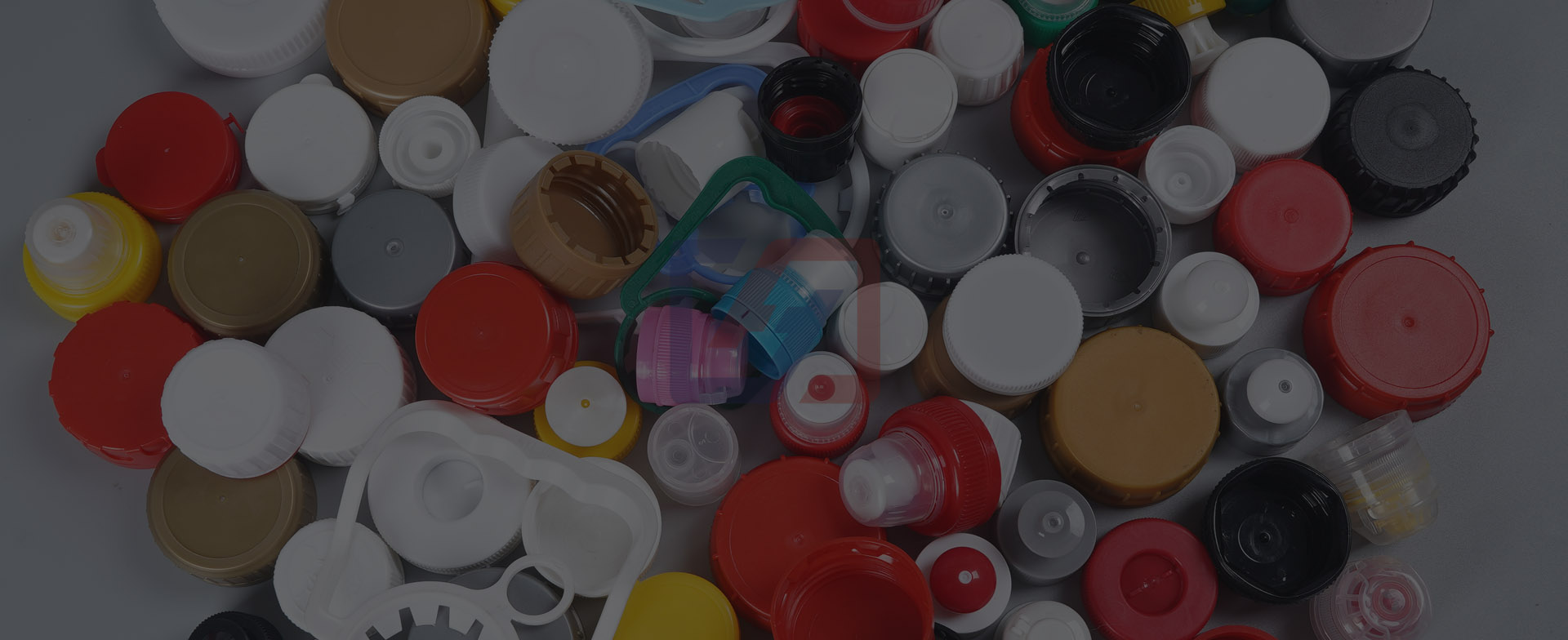
Every cap manufacturer faces the same fundamental question: how many cavities should my mold have?
More cavities mean higher output per cycle, potentially lower cost per cap, and greater production capacity. But more cavities also mean higher mold cost, more demanding machine requirements, greater complexity, and increased maintenance.
There is no single right answer. The optimal cavitation depends on production volume, required flexibility, capital availability, machine compatibility, and quality requirements.
This article provides a comprehensive economic comparison of 48, 72, and 96-cavity cap molds. Using real-world data from Shuanghao installations, we examine output capacity, capital costs, operating expenses, and return on investment to help you make an informed decision.
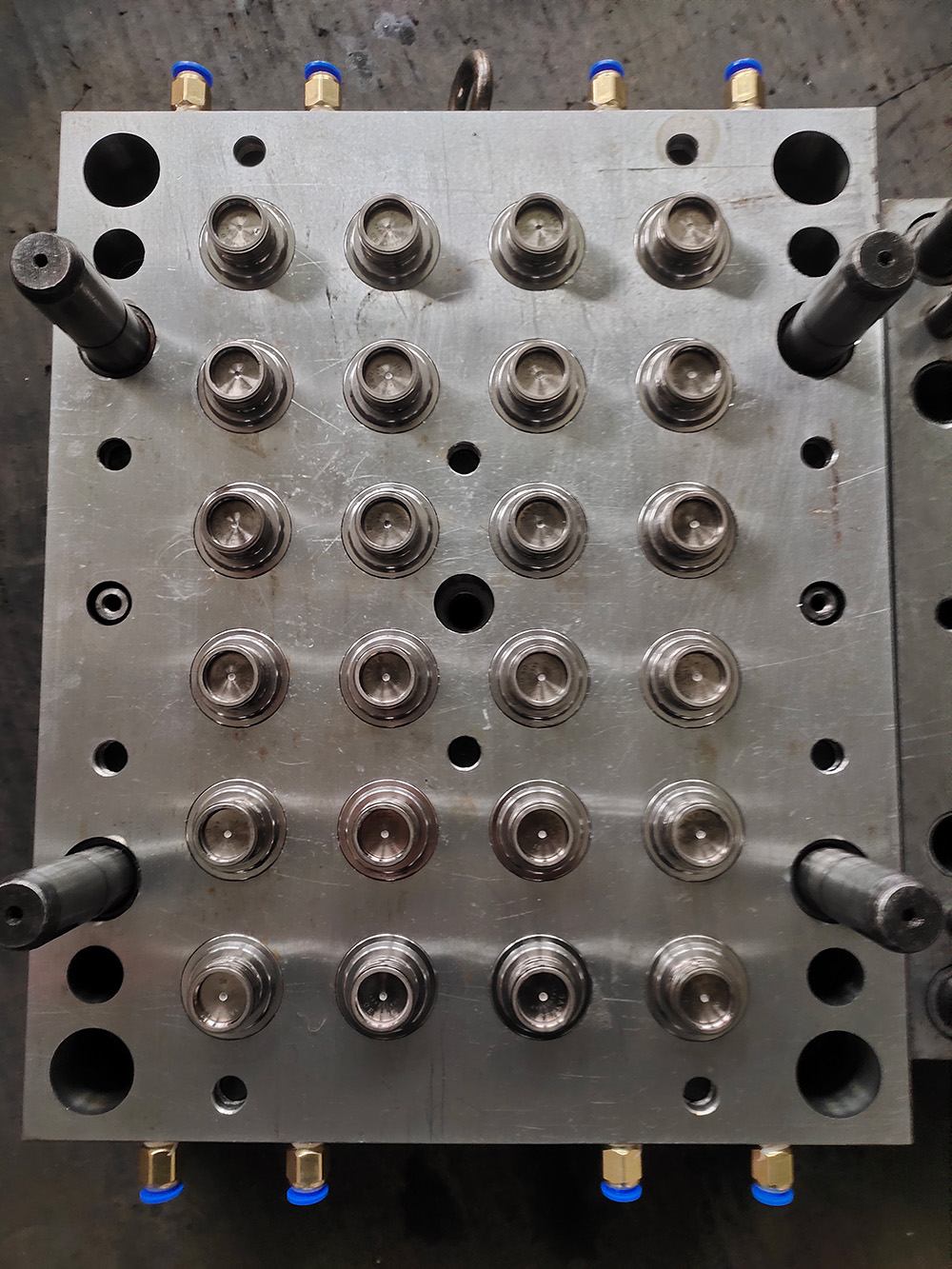
The most obvious difference between cavitation levels is output.
Basic Output Calculations
At a 6-second cycle time, a 48-cavity mold produces approximately 28,800 caps per hour. A 72-cavity mold produces approximately 43,200 caps per hour. A 96-cavity mold produces approximately 57,600 caps per hour.
But cycle time is not constant across cavitation levels. Higher cavitation molds may require slightly longer cycles due to cooling demands. These differences affect real-world output.
Real-World Output Comparison
Based on Shuanghao installation data for 28mm water bottle caps:
| Cavitation | Typical Cycle Time | Output per Hour | Output per Year (8,000 hrs) |
|---|---|---|---|
| 48 cavities | 5.5 - 6.5 sec | 26,600 - 31,400 | 213 - 251 million |
| 72 cavities | 6.0 - 7.0 sec | 37,000 - 43,200 | 296 - 346 million |
| 96 cavities | 6.5 - 7.5 sec | 46,100 - 53,200 | 369 - 425 million |
The 72-cavity mold produces 40 to 60 percent more caps annually than the 48-cavity mold. The 96-cavity mold produces 70 to 100 percent more caps annually than the 48-cavity mold.
Higher cavitation molds cost more to design, manufacture, and tool.
Mold Cost Components
Mold cost includes base mold price, cavity and core manufacturing, hot runner system, cooling system, and ejection system. Additional cavitation adds cost for additional cavities, more complex hot runner manifolds, more extensive cooling circuits, and larger mold bases.
Typical Cost Ranges
Based on Shuanghao pricing for standard 28mm water bottle caps:
| Cavitation | Typical Mold Cost | Cost per Cavity |
|---|---|---|
| 48 cavities | 65,000 | 1,350 |
| 72 cavities | 95,000 | 1,320 |
| 96 cavities | 125,000 | 1,300 |
Cost per cavity typically decreases slightly as cavitation increases, due to shared components.
Machine Cost Implications
Higher cavitation molds require larger injection molding machines.
| Cavitation | Minimum Clamp Force | Machine Cost Premium |
|---|---|---|
| 48 cavities | 250 - 350 tons | Baseline |
| 72 cavities | 350 - 500 tons | +15 - 25% |
| 96 cavities | 500 - 750 tons | +30 - 50% |
If existing machines cannot accommodate higher cavitation, new machine investment may be required.
Operating costs vary significantly by cavitation.
Labor Cost
Output per operator hour is higher with more cavities. Assuming one operator per machine, labor cost per thousand caps decreases as cavitation increases.
At a typical operator cost of $50,000 per year:
| Cavitation | Annual Output | Labor Cost per 1,000 Caps |
|---|---|---|
| 48 cavities | 230 million | $0.22 |
| 72 cavities | 320 million | $0.16 |
| 96 cavities | 400 million | $0.13 |
Energy Cost
Larger machines consume more energy. However, energy per cap decreases with higher cavitation.
Assuming $0.10 per kWh:
| Cavitation | Machine Power | Energy per 1,000 Caps |
|---|---|---|
| 48 cavities | 40 - 60 kW | 0.58 |
| 72 cavities | 55 - 80 kW | 0.50 |
| 96 cavities | 70 - 100 kW | 0.44 |
Maintenance Cost
Higher cavitation molds have more components and may require more maintenance. However, maintenance cost per cap is typically lower.
| Cavitation | Annual Maintenance Cost | Maintenance per 1,000 Caps |
|---|---|---|
| 48 cavities | 5,000 | 0.02 |
| 72 cavities | 7,000 | 0.02 |
| 96 cavities | 9,000 | 0.02 |
Material Cost
Material cost per cap is approximately the same across cavitation levels. Slightly higher scrap rates with higher cavitation may increase material cost by 0.2 to 0.5 percent.
Combining all operating costs:
| Cost Component | 48 Cavities | 72 Cavities | 96 Cavities |
|---|---|---|---|
| Labor | $0.22 | $0.16 | $0.13 |
| Energy | $0.48 | $0.42 | $0.38 |
| Maintenance | $0.02 | $0.02 | $0.02 |
| Material | $5.00 | $5.02 | $5.04 |
| Total Operating Cost | $5.72 | $5.62 | $5.57 |
The 72-cavity mold reduces operating cost by approximately 1.7 percent compared to 48-cavity. The 96-cavity mold reduces operating cost by approximately 2.6 percent.
Capital cost per cap decreases with higher cavitation.
Mold Amortization
Assuming a 5-year amortization period and 8,000 operating hours per year:
| Cavitation | Annual Mold Cost | Caps per Year | Mold Cost per 1,000 Caps |
|---|---|---|---|
| 48 cavities | $11,000 | 230M | $0.048 |
| 72 cavities | $16,000 | 320M | $0.050 |
| 96 cavities | $21,000 | 400M | $0.053 |
Machine Amortization
Assuming the same 5-year amortization with baseline machine cost of $200,000 for 48-cavity:
| Cavitation | Machine Cost | Annual Machine Cost | Machine Cost per 1,000 Caps |
|---|---|---|---|
| 48 cavities | $200,000 | $40,000 | $0.174 |
| 72 cavities | $240,000 | $48,000 | $0.150 |
| 96 cavities | $280,000 | $56,000 | $0.140 |
Combining operating and capital costs:
| Cost Component | 48 Cavities | 72 Cavities | 96 Cavities |
|---|---|---|---|
| Operating Cost | $5.72 | $5.62 | $5.57 |
| Mold Amortization | $0.048 | $0.050 | $0.053 |
| Machine Amortization | $0.174 | $0.150 | $0.140 |
| Total Cost | $5.942 | $5.820 | $5.763 |
The 72-cavity mold reduces total cost by approximately 2.1 percent compared to 48-cavity. The 96-cavity mold reduces total cost by approximately 3.0 percent.
How long does it take to recover the higher initial investment?
48 vs 72 Cavities
Additional investment for 72-cavity: 40,000 (machine) = $60,000.
Annual savings with 72-cavity: 230 million caps × (5.820)/1,000 = $28,060.
Simple payback period: 28,060 = 2.1 years.
48 vs 96 Cavities
Additional investment for 96-cavity: 80,000 (machine) = $120,000.
Annual savings with 96-cavity: 230 million caps × (5.763)/1,000 = $41,170.
Simple payback period: 41,170 = 2.9 years.
72 vs 96 Cavities
Additional investment for 96-cavity from 72-cavity: 40,000 (machine) = $60,000.
Additional savings with 96-cavity from 72-cavity: 320 million caps × (5.763)/1,000 = $18,240.
Simple payback period: 18,240 = 3.3 years.
Economics alone should not drive the decision.
Production Flexibility
48-cavity molds offer greater flexibility for shorter runs. They can be changed over more quickly. They are less affected by downtime. They allow more frequent product changes.
For manufacturers with many SKUs or frequent changeovers, 48-cavity may be optimal despite higher per-cap cost.
Machine Compatibility
Not all facilities have machines capable of running 72 or 96-cavity molds. Retrofitting or purchasing new machines adds cost and complexity.
Quality Risk
Higher cavitation molds are more complex. The risk of cavity-to-cavity variation increases. The impact of a single cavity failure is greater (more lost output). Maintenance is more demanding.
For tight-tolerance applications, lower cavitation may provide more consistent quality.
Space Constraints
Higher cavitation molds require larger machines. Floor space may be limited.
When to Choose 48 Cavities
Annual volume under 150 million caps per machine. Frequent changeovers (more than 2-3 per week). Tight quality tolerances. Limited machine capacity. Budget constraints for capital investment.
When to Choose 72 Cavities
Annual volume 150 to 300 million caps per machine. Moderate changeover frequency (1-2 per week). Standard quality requirements. Adequate machine capacity. Available capital for moderate investment.
When to Choose 96 Cavities
Annual volume over 300 million caps per machine. Infrequent changeovers (less than 1 per week). Standard quality requirements. Large machine capacity available. Available capital for higher investment.
Customer Case: High-Volume Water Bottler
A water bottler producing 1 billion caps annually had 12 machines running 48-cavity molds at 5.8-second cycles.
Shuanghao analysis showed that converting to 96-cavity molds would require 6 machines instead of 12.
The customer invested in 6 new machines and 96-cavity molds. Labor cost was reduced by 50 percent. Floor space was reduced by 40 percent. Total cost per cap decreased by 8 percent. Payback period was 2.5 years.
Customer Case: Specialty Cap Manufacturer
A specialty cap manufacturer with 50 different SKUs needed flexibility. Annual volume was 50 million caps per SKU maximum.
Shuanghao recommended 48-cavity molds for their flexibility and faster changeovers. The customer accepted higher per-cap cost for greater responsiveness. Customer satisfaction improved with faster delivery.
Shuanghao's economic analysis capabilities provide output projections based on your specific product and cycle time. Capital cost estimates for molds, machines, and auxiliary equipment. Operating cost calculations for labor, energy, and maintenance. Break-even analysis comparing cavitation options. Recommendations based on your production profile: volume, changeovers, quality requirements, and budget.
There is no universal "best" cavitation. The optimal choice depends on your specific production requirements, capital availability, and business strategy.
For pure cost efficiency at high volume, 72 or 96-cavity molds deliver lower per-cap costs. For flexibility and lower capital investment, 48-cavity molds remain excellent choices.
Shuanghao's economic analysis tools help you make data-driven decisions based on your actual production profile. We work with you to evaluate output requirements, changeover frequency, quality tolerances, machine compatibility, and capital budget.
The result is a cavitation recommendation that optimizes your total cost of ownership and supports your business objectives.
Choose Shuanghao. Choose the right cavitation for your success.