
The flip-top cap is one of the most popular closure designs in the world. It adorns shampoo bottles in bathrooms, ketchup bottles in kitchens, sports drinks on playing fields, and lotion bottles on dressing tables. Its appeal is simple: one-handed opening, no cap to drop or lose, and satisfying closure.
But behind this simple consumer experience lies extraordinary engineering. The flip-top cap must open smoothly millions of times without hinge failure. It must seal tightly when closed. It must resist fatigue, chemicals, and temperature extremes. And it must do all this while being manufactured by the billions at low cost.
At Shuanghao, we have specialized in flip-top cap molds for decades. This article reveals the engineering principles that enable flip-top caps to deliver millions of reliable closures.
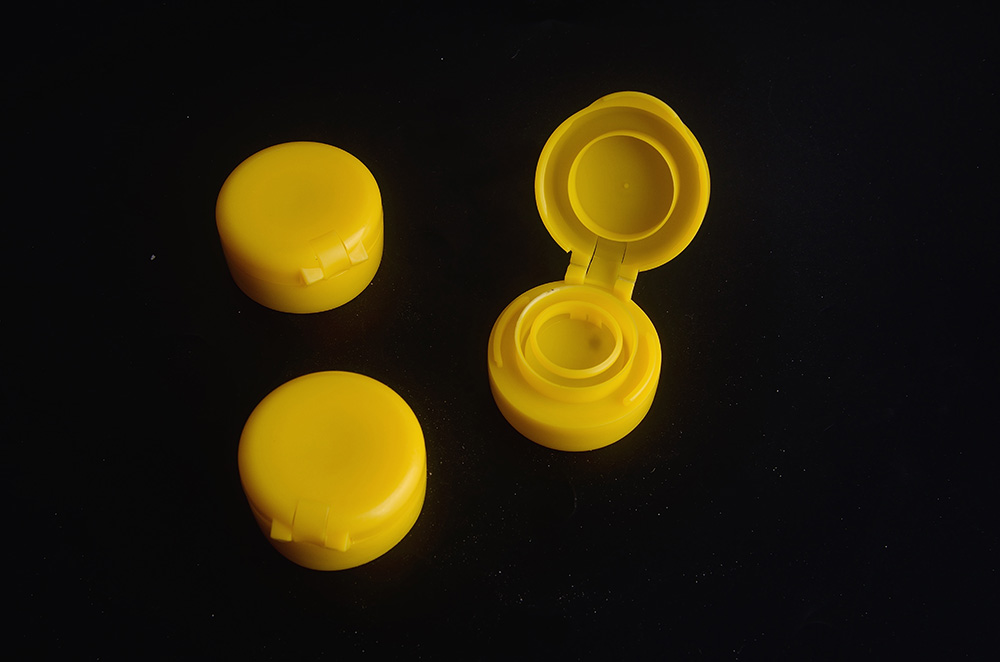
Flip-top caps are fundamentally different from standard screw caps. They contain a moving part—the hinged flap—that must function reliably over the life of the product.
The Living Hinge
The hinge of a flip-top cap is typically a living hinge. Unlike mechanical hinges with pins and springs, a living hinge is a thin section of plastic that flexes repeatedly. It is molded as part of the cap, requiring no assembly.
The living hinge must flex open and closed thousands or millions of times without cracking, whitening, or losing restoring force. This is an extraordinary demand on a plastic component.
Failure Modes
When flip-top caps fail, they typically fail in one of several ways. Hinge cracking occurs when the hinge develops cracks that propagate until the flap separates. Hinge whitening is stress-induced crystallization that weakens the hinge over time. Loss of closing force occurs when the hinge loses its spring, allowing the flap to open unintentionally. Seal failure happens when the flap does not close fully or the sealing surface deforms.
Each failure mode is influenced by mold design, material selection, and processing conditions.
The living hinge is the heart of the flip-top cap. Its design determines the cap's durability and feel.
Hinge Geometry
The living hinge is typically a thin strip of material connecting the cap body to the flap. Key geometric parameters include hinge thickness, hinge length, hinge width, and hinge transition radii.
Hinge thickness is the most critical parameter. Typical living hinge thickness for polypropylene is 0.2 to 0.4 millimeters. Too thick, and the hinge will be stiff and may crack from over-stressing. Too thin, and the hinge will be weak and may tear.
Hinge length affects the range of motion. Longer hinges allow greater opening angles but may be less stable. Shorter hinges provide more positive closure but limit opening angle.
Hinge width distributes stress across the hinge. Wider hinges are stronger but stiffer. The optimal width balances strength and flexibility.
Hinge transition radii where the hinge meets the thicker body and flap sections are critical. Sharp corners concentrate stress and initiate cracks. Generous radii of 0.3 to 0.5 millimeters distribute stress.
Hinge Orientation
The hinge must be oriented to flex in the correct direction. Molecular orientation during molding significantly affects hinge performance. Shuanghao designs gates and flow paths to align polymer molecules across the hinge, not along it. This cross-orientation provides maximum flexural fatigue resistance.
Material choice dramatically affects flip-top cap durability.
Preferred Materials
Polypropylene is the dominant material for flip-top caps. It offers excellent flexural fatigue resistance, surviving hundreds of thousands of flex cycles. It has good chemical resistance for most personal care and food products. It is relatively low cost and easy to process. It provides good living hinge performance when properly oriented.
High-density polyethylene is also used for some flip-top caps. It offers better chemical resistance than polypropylene but has poorer fatigue resistance. It is stiffer, requiring different hinge designs. It is more common for industrial or chemical closures.
Material Properties for Hinges
Melt flow index affects how material flows through thin hinge sections. Shuanghao recommends MFI of 10 to 25 grams per 10 minutes for flip-top caps. Lower MFI provides better strength but may not fill thin hinges completely. Higher MFI fills thin sections easily but may have lower fatigue resistance.
Additives can enhance hinge performance. Nucleating agents improve crystallinity for better fatigue resistance. Elastomer modifiers increase flexibility and impact resistance. Slip agents reduce friction between the flap and body.
Shuanghao's flip-top cap molds incorporate several specialized design features.
Hinge Cavity Design
The hinge cavity is the most critical feature in a flip-top cap mold. Shuanghao designs hinge cavities with precision thickness control. The hinge thickness is held to plus or minus 0.02 millimeters. This precision ensures consistent hinge flexibility from cavity to cavity and mold to mold.
The hinge cavity must be polished to a mirror finish to prevent stress concentrations. Ra 0.1 micrometers or better is typical. Any surface defect will become a crack initiation point.
Gate Placement for Hinge Orientation
Gate placement controls molecular orientation across the hinge. Shuanghao places gates to create flow across the hinge, not along it. This cross-flow aligns polymer molecules perpendicular to the hinge axis, providing maximum fatigue resistance.
For multi-cavity molds, gate placement must be consistent for every cavity. Shuanghao's balanced hot runner systems ensure identical flow conditions across all cavities.
Hinge Cooling
The thin hinge section cools much faster than the thick body and flap sections. This differential cooling can create residual stress that affects hinge performance. Shuanghao's cooling systems balance heat extraction across the entire cap. Insulated runner systems may be used to keep the hinge area warmer longer. Zone-specific cooling allows independent control of body, hinge, and flap temperatures.
Ejection Considerations
The hinged flap can be difficult to eject cleanly. Shuanghao designs ejection systems specifically for flip-top caps. Lifters or slides may be required for undercut features. Ejector pin placement must avoid the hinge area. Air ejection can assist with delicate flap release.
Proper processing is essential for achieving maximum hinge life.
Melt Temperature Control
Melt temperature affects both flow and material properties. Shuanghao recommends melt temperatures at the lower end of the material supplier's range for hinge applications. Lower melt temperatures increase molecular orientation, improving hinge fatigue resistance. However, melt temperature must be high enough to fill thin hinge sections completely.
Typical melt temperature for polypropylene flip-top caps is 200 to 220 degrees Celsius.
Mold Temperature Control
Mold temperature affects crystallization and residual stress. Shuanghao recommends mold temperatures of 30 to 50 degrees Celsius for polypropylene flip-top caps. Higher mold temperatures promote crystallization, improving hinge strength. However, higher mold temperatures increase cycle time.
Injection Speed and Pressure
Injection speed affects how material fills the thin hinge section. Shuanghao recommends moderate to high injection speed to fill hinges before material freezes. High injection speed also increases molecular orientation across the hinge. However, excessive speed can cause flash or part sticking.
Packing and Cooling
Packing pressure must be sufficient to prevent sink marks without over-packing the hinge. Shuanghao recommends lower packing pressure for flip-top caps than for standard caps. Cooling time must allow the hinge to solidify completely before ejection. Premature ejection can stretch or damage the hinge.
Shuanghao validates flip-top cap performance through comprehensive testing.
Hinge Flex Testing
Hinge flex testing cycles the flap open and closed repeatedly to simulate product use. Manual testing uses hand cycling for low-volume validation. Automated flex testers cycle caps at controlled rates for high-volume validation. Typical test protocols require 5,000 to 20,000 cycles without failure. Premium applications may require 50,000 cycles or more.
During flex testing, caps are inspected for hinge cracking, whitening, loss of closing force, and seal integrity.
Opening Force Measurement
Opening force affects consumer perception of quality. Too difficult, and consumers struggle to open the cap. Too easy, and the cap may open unintentionally. Shuanghao measures opening force using force gauges that record the peak force required to open the flap. Typical opening force targets range from 5 to 15 Newtons depending on application.
Closing Force Measurement
Closing force affects seal integrity and consumer satisfaction. Shuanghao measures the force required to close the flap. The closing force should be sufficient to ensure the cap stays closed but not so high that consumers struggle.
Seal Integrity Testing
The flap must seal completely when closed. Shuanghao uses vacuum decay testing to measure seal integrity. Caps are closed and subjected to vacuum. Pressure decay indicates leakage. Leakage rates below 0.1 cubic centimeters per minute are typical for quality flip-top caps.
Problem: Hinge Cracking During Flex Testing
Hinge cracking indicates insufficient fatigue resistance. Solutions include increasing hinge thickness within the optimal range, improving molecular orientation across the hinge, reducing melt temperature to increase orientation, and adding elastomer modifiers to the material.
Problem: Hinge Whitening
Hinge whitening indicates stress-induced crystallization. Solutions include increasing hinge thickness slightly, reducing injection speed to decrease shear heating, increasing mold temperature for slower cooling, and verifying material is dry and stable.
Problem: Weak Closing Force
Weak closing force indicates hinge relaxation or poor design. Solutions include increasing hinge thickness, adding hinge geometry such as living hinge straps, verifying material has adequate stiffness, and checking for over-packing that compresses the hinge.
Problem: Flap Not Sealing Completely
Poor sealing indicates warpage or dimensional issues. Solutions include verifying flatness of sealing surfaces, checking for sink marks on the flap, balancing cooling to prevent warpage, and inspecting for flash on sealing surfaces.
Customer Case: Personal Care Product Manufacturer
A personal care product manufacturer was experiencing hinge failures on their shampoo bottle flip-top caps. Caps were failing after 2,000 to 3,000 cycles, well below the 10,000-cycle requirement.
Shuanghao analyzed the existing mold and process. The hinge thickness was inconsistent, ranging from 0.25 to 0.45 millimeters. Gate placement was causing flow along the hinge rather than across it.
Shuanghao redesigned the hinge cavity with consistent thickness of 0.30 millimeters plus or minus 0.02 millimeters. Gate placement was modified to create cross-hinge flow. Melt temperature was reduced from 230 to 210 degrees Celsius.
The redesigned caps achieved 25,000 flex cycles without failure. The customer's product warranty was extended from 2 years to 5 years.
Customer Case: Food Packaging Company
A food packaging company needed a flip-top cap for a new condiment line. The cap would be opened and closed hundreds of times over its use life. Consistent opening force and reliable sealing were critical.
Shuanghao designed a custom flip-top cap mold with precision hinge cavity, balanced cooling system, and optimized gate placement.
The caps achieved consistent opening force of 8 to 10 Newtons across all 48 cavities. Hinge flex testing exceeded 15,000 cycles. The product launched successfully and has become the company's best-selling condiment line.
Shuanghao's flip-top cap molds deliver engineering for millions of reliable closures through precision hinge cavity design with consistent thickness and smooth transitions, material selection guidance for optimal fatigue resistance, mold design with cross-hinge flow orientation and balanced cooling, processing recommendations for maximum hinge durability, and comprehensive testing validation.
Flip-top caps are engineering marvels that consumers take for granted. Behind every satisfying snap-open and click-closed is a precision-engineered living hinge that must flex millions of times without failure.
Shuanghao's flip-top cap molds are engineered for this reliability. Through precision hinge cavity design, optimized gate placement for molecular orientation, careful material selection, balanced cooling systems, and rigorous testing validation, we produce molds that deliver millions of reliable closures.
Whether you produce flip-top caps for personal care, food, beverage, or pharmaceutical applications, Shuanghao has the expertise to engineer molds that consumers can rely on.
Choose Shuanghao. Choose flip-top reliability.