Micro-Conformal Cooling for Cap Molds: How DMLS-Printed Channels Reduce Cycle Time by 15-25%
Published by cap-bottle — Premier China Bottle Cap Mold Manufacturer & High-Precision Closure Tooling Engineer
1. Introduction: The Thermal Bottleneck in High-Speed Plastic Closure Molding
In high-cavitation plastic bottle cap manufacturing, cooling time represents over 60% to 70% of the total injection molding cycle. As closure wall thicknesses are aggressively reduced for lightweighting, managing localized heat concentration—particularly around the injection gate, thread profiles, and internal sealing lip (bore seal)—becomes the ultimate operational challenge.
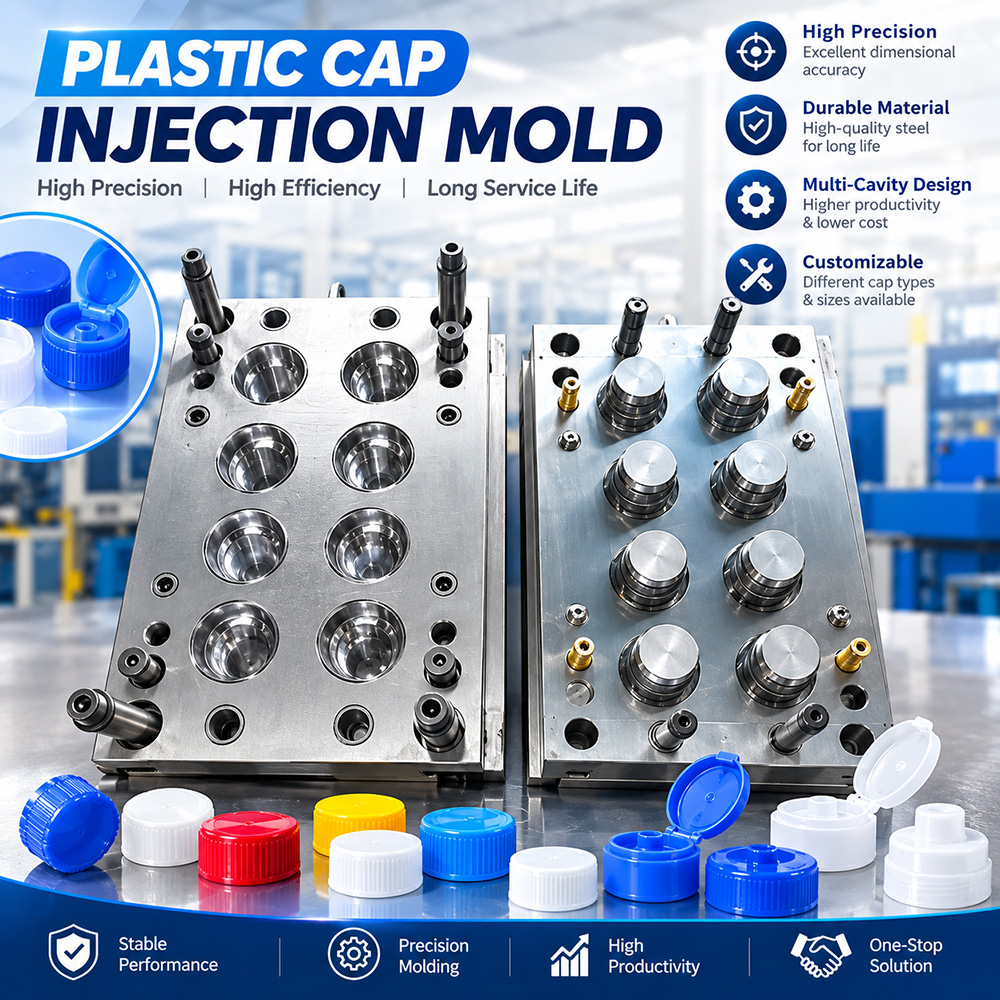
Conventional straight-drilled cooling channels are inherently constrained by linear geometry. They leave substantial thermal dead zones in intricate core tips and cavity necks, forcing molders to extend hold and cooling times to prevent ovality, sink marks, and post-ejection cap warping. As a pioneer in specialized cap tooling, cap-bottle integrates Direct Metal Laser Sintering (DMLS) additive manufacturing to engineer micro-conformal cooling inserts that follow the exact 3D contours of the closure, consistently reducing dry cycle times by 15% to 25%.
2. Polymer Thermal Physics: Why Micro-Conformal Cooling Is Essential
During the high-speed injection of semi-crystalline polymers like High-Density Polyethylene (HDPE) and Polypropylene (PP), molten resin enters the mold cavity at temperatures between 200°C and 240°C. To safely eject the cap without thread distortion or seal line shrinkage, the core and cavity inserts must rapidly extract thermal energy down to the heat deflection temperature (HDT).
The Mechanics of Thermal Micro-Gradients and Defects:
- Thermal Hot Spots at Core Tips: Standard core cooling relies on baffles or bubblers, which suffer from fluid stagnation. The core tip remains elevated in temperature, leading to differential shrinkage and thread ovality.
- Gate Area Crystallization Variance: Non-uniform cooling around the central valve gate causes uneven polymer crystallization, increasing gas permeability and structural fragility in CSD closures.
- Internal Stress & Stripping Failure: Asymmetrical cooling across the cap wall causes localized adhesion to core steel, resulting in torn tamper-evident bands during high-speed mechanical stripping.
3. DMLS 3D Additive Manufacturing Engineering at cap-bottle
To overcome mechanical drilling limitations, cap-bottle utilizes advanced metal 3D printing (Direct Metal Laser Sintering) with high-thermal-conductivity tool steel alloys (Corrax Stainless / MS1 Maraging Steel / Beryllium Copper hybrids) to fabricate micro-conformal cooling channels.
| Thermal Engineering Vector | Standard Drilled Baffle/Bubbler Cooling | cap-bottle DMLS Micro-Conformal Cooling |
|---|---|---|
| Channel Geometry & Path | Linear intersecting drilled lines | 3D helical & spiral channels contoured within 1.5mm–2.5mm of the cap surface |
| Cross-Sectional Architecture | Uniform circular bored holes | Optimized teardrop / elliptical channels designed to maximize surface area and prevent pressure drop |
| Coolant Flow Dynamics | Laminar flow with low heat transfer rates | Turbulent micro-vortex flow (Reynolds Number Re > 4,000) for maximum heat dissipation |
| Cycle Time Impact | 3.2s – 4.5s average cycle time | 2.2s – 2.8s fast cycle time (15–25% overall reduction) |
4. Computational Fluid Dynamics (CFD) & Thermal Stress Analysis
Prior to DMLS sintering, cap-bottle engineers run conjugate heat transfer (CHT) and CFD simulations to optimize coolant flow velocity, pressure distribution, and thermal extraction uniformity across every drop in multi-cavity tools.
- Equidistant Channel Profiling: Maintaining a strict 2.0mm channel-to-wall distance prevents localized hot spots while sustaining steel fatigue strength under 1,400 bar packing pressure.
- Micro-Turbulence Optimization: Internal channel wall texturing generated during selective laser melting promotes turbulent fluid mixing without inducing coolant pump cavitation.
- Equalized Multi-Cavity Heat Extraction: Balanced manifold cooling loops ensure that central and peripheral mold cavities maintain identical thermal dissipation profiles within ±0.5°C.
5. Economic Return and Field Yield Improvements for Bottlers
Implementing DMLS-printed micro-conformal cooling inserts in high-cavitation cap molds directly translates into substantial production efficiency and financial performance gains:
- Up to 25% Productivity Gain: Shaving 0.6 to 1.0 seconds off cycle times yields millions of additional caps annually on existing injection machinery.
- Elimination of Cap Deformation: Rapid, uniform cooling locks in strict thread dimensions and inner bore seal concentricity, guaranteeing zero leak rates on automated capping lines.
- Extended Tool Steel Reliability: Uniform thermal distribution minimizes thermal fatigue stress cycles, preventing micro-cracking across parting lines and core tips.
Partner with cap-bottle for High-Speed Closure Tooling Innovation
At cap-bottle, we combine state-of-the-art metal additive manufacturing, Swiss high-speed CNC machining, and decades of closure tooling expertise. Whether you produce mineral water caps, CSD closures, edible oil caps, or complex sports caps, our technical team delivers customized micro-conformal cooling mold solutions engineered for maximum cycle efficiency and long-term operating profit.